


Nobility in Europe
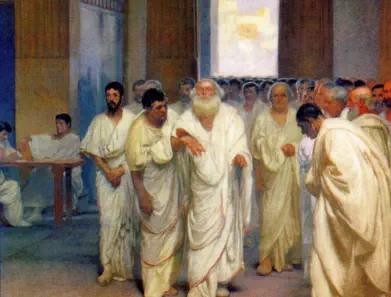
Antiquity The concept of "nobility" in the European Middle Ages, which was developed largely in the 19th century, can only be transferred to the ancient cultures of the Greeks and Romans to a limited extent. Here, unlike in feudal societies since the European Middle Ages, the most outstanding characteristic of the nobility was not their lineage, but their achievements or "bestness" (Greek arete, Latin nobilitas). The ancient aristocracy derived its claim to power from a special achievement (for the state) rather than from the good fortune of being born into a particular family. For example, the Roman Senate granted Gaius Julius Caesar the right to appoint new patricians with the Lex Cassia (44 BC). Emperor Augustus, who had been a patrician since his testamentary adoption by Julius Caesar, had the Senate grant him such a right with the Lex Saenia (29 BC), which was also exercised by Augustus' successors. The reason was Lucius Saenius, who – like other lower officials – allowed himself to be used as a tool by Augustus and in return became suffect consul. Ancient Greece Due to a lack of written sources, there is little reliable information about ancient Greece, such as the kingship in Sparta or the rule in the Kingdom of Macedonia. Unlike the power of the Phoenicians, which was based on trade and seafaring, the aristocratic supremacy in Sparta and Corinth was based primarily on extensive land ownership, holding priestly offices and the privilege of jurisprudence, even including the slave trade (debt bondage). A characteristic feature was a division of society into the "noble and rich" (kalokagathia) and the "poor". In particular, keeping horses and taking part in horse and chariot races at the Olympic Games were reserved for the nobility. One example is the "hippobots" (the mounted nobility) on Euboea. The aristocracy, which had degenerated into oligarchy and tyranny, developed into the democratic polis in city states such as ancient Athens. Ancient Rome In ancient Rome there was a class of equites (knights), which is sometimes interpreted as "lower nobility". The rise of a Roman to a higher class up to knight was possible, but was largely determined by fixed wealth limits (cf. census suffrage). This hierarchy probably dates back to early Roman times, when society was structured according to the military order. Position in the army was determined by the equipment one had to provide oneself; accordingly, wealthier people took higher positions. In this sense, an eques is a soldier on horseback. Researchers are divided on the exact position of these warriors. It is certain that from the Punic Wars onwards, the importance of the eques was primarily based on the economic sphere. As a wealthy class without the honorary duties of senators, they could take on sovereign tasks leased by the state, for example the collection of indirect taxes and customs duties. From 186, Emperor Commodus referred to himself as nobilitas Augusti in order to justify his now controversial rule by means of a supposed relationship with Emperor Augustus. In the 3rd century, the term nobilissimus became common for the Caesar as the designated successor of the ruler, which merely identified him as the ruler's son. The former holders of consular offices (see also Cursus honorum) and their descendants formed the senatorial nobility. Unlike knighthood, the senatorial rank was not awarded by the emperor, but could only be inherited. The senatorial nobility lost importance during the imperial crisis of the 3rd century; however, the senators mostly retained the basis of power (large landholdings, finances, and social and political influence). Since Emperor Constantine, this became an exclusive rank designation. The senatorial nobility only developed a noble class consciousness in late antiquity. Until the 6th century, it referred to its members as nobiles and senatores and marked the slow transition to the nobility of the Middle Ages. However, the late antique Gallo-Roman senatorial nobility still had considerable influence in the early Merovingian period.